

Industries › Offshore wind
Industries
Offshore wind
Data that takes the risk out of offshore wind, on substations, met masts and fixed and floating foundations.
An offshore wind development measures the same sea twice. Once for the consent it was granted, where the record has to stand up years later, and once for the work in front of it, where the question is whether a technician can transfer this morning and whether the crane can lift this afternoon.
As offshore wind scales up, costs will mostly come down through lower risk rather than new technology. That depends on knowing, not assuming, what the weather, the sea and the structure are doing, and on a verified record from construction through operation that your team, your certifiers and your insurers can work from.
What has to be measured here
The instruments sit on structures that are expensive to reach, and the conditions they report decide when anyone reaches them. That puts as much weight on a reading being available as on it being right.
Wind, wave, current and visibility
For transfer, lifting and vessel operations, against the limits written into the method statement.
Meteorological and oceanographic records
For consent reporting and for characterising the site over the life of the development.
Helideck conditions
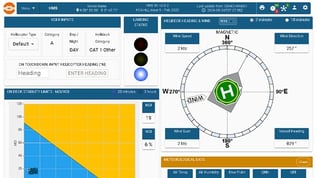
Where the asset carries a deck: wind, visibility, cloud base, pressure and temperature, and on a moving deck pitch, roll and significant heave rate, presented the way the approving regulation requires.
Structural loads, motion and position
On the structure itself, over its whole life. Operators are planning to run assets well beyond their original design life, and that decision needs a record of what the structure has actually been through, not only what it was designed for. On floating foundations the measurement also has to account for the platform moving and the mooring holding it on station.
Bird and bat activity
Recorded against the conditions in which it occurred, so that a curtailment decision can be explained afterwards.
Camera coverage
Covering the places people cannot safely stand.
Typical systems on these assets
These are the areas an offshore wind scope usually draws on. Most deliveries combine several of them into a single system.
MetOcean and weather monitoring
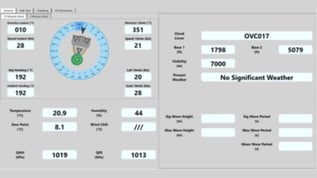
Wind, wave, current, visibility and air and sea conditions, engineered and presented as one Environmental Monitoring System.
Explore →
Helideck and aviation monitoring
Where the asset carries a deck, the Helideck Monitoring System reports and records the conditions a helicopter has to land in, to the standard the deck is approved under.
Explore →
Structural and motion monitoring
How the structure responds and moves, fixed or floating, building the load history an operator needs when deciding whether a foundation or a floater can run for longer.
Explore →
Position and mooring monitoring
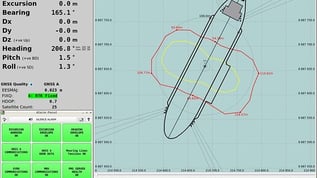
On floating foundations, the RUP Excursion Monitoring System tracks the unit against its excursion envelope, with mooring line tension calculated from its position.
Explore →
Environmental and wildlife monitoring
Bird and bat detection with our partners Spoor and DeTect, with the installation around it monitored and operated from Orbalux.
Explore →
Visual monitoring
Camera systems covering the parts of the structure that cannot be reached, or cannot safely be watched from anywhere else.
Explore →
Forecasting weather systems
Site weather data collected locally and shared securely through Orbalux, so a forecast provider can run its model on the conditions actually measured on site.
Explore →
How WISE Group works on these assets
WISE Group has been in offshore monitoring for over 30 years, and approaches a wind development the way it approaches any offshore asset: the scope is taken as a whole. We establish what has to be measured and which standard applies, engineer the instruments, software, displays and interfaces into one system, deliver it with the documentation and testing the build requires, and support it for the life of the asset.
On larger developments that often means working inside someone else's package. WISE Group is frequently the monitoring supplier behind a telecom system integrator, an EPC contractor or a yard, which puts as much weight on interface definition, documentation, factory testing and delivery coordination as on the instruments themselves.
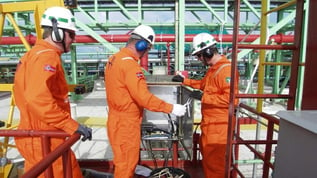
Afterwards the same team keeps the system running: spares, service visits, and on-site system verification, in which installed sensors are compared against recently calibrated reference sensors brought to site. Calibration itself is a laboratory activity, and we manage those returns on your behalf with the manufacturer or a certified laboratory.
Throughout, we treat data quality as part of the delivery: automatic validity checks, documented calculation methods and continuous logging, so the record holds up when a certifier, insurer or investigator asks for it.
Scoping
What we will need to know
Most wind enquiries arrive as a specification rather than a blank sheet. These are the points that decide the scope.
- Which structures carry instruments, and what access the site has to them
- Which operations the data has to authorise, and the limits written against them
- What the consent requires to be recorded, and for how long
- Which systems the data has to reach, and in what format
- Whether the foundation is fixed or floating and, if floating, how it is moored and what its excursion limits are
- The environment classification, and any Ex requirements
Tell us those and we will come back with a system description you can put into a specification.
Where to next
Offshore wind is one of four asset types we work on most. Every system named on this page is described in full in the Systems section.
In this area: Industries overview · Oil and gas · Marine and vessels · LNG and terminals
Related systems: MetOcean and weather monitoring · Helideck Monitoring System · Wildlife monitoring · Excursion monitoring
Also useful: Weather Stations · CAP 437 standards · Sensors · Service and support
Useful to include
- Which structures carry instruments, and what access the site has to them
- Which operations the data has to authorise
- Whether the foundation is fixed or floating
What happens next
We review the asset and the monitoring requirement.
We define the systems, sensors and interfaces.
You get a system description and a scope for delivery and support.
Get in touch
Tell us about the development and what the data has to authorise, and we will come back with a system description you can put into a specification.
You can also contact us directly.