







Software › RUPDB
Software
RUPDB SCADA Software
Real-time monitoring platform for marine and energy systems
RUPDB is WISE Group’s real-time data acquisition and processing platform engineered for precision monitoring systems in offshore and industrial environments. It is not a generic SCADA toolkit offered as a standalone product, but a controlled software environment developed to execute defined monitoring functions with deterministic behaviour and long-term stability.
The platform has evolved through continuous deployment in marine installations where positional accuracy, motion awareness and structured alarm handling are critical. Its architecture reflects the operational realities of offshore environments: sustained operation, high-frequency data streams, and the need for traceable, mathematically consistent system behaviour.
Core architectural principles
RUPDB is designed around a layered processing model that separates acquisition, computation, alarm logic and storage. This ensures predictable execution and transparent system behaviour under sustained operational load.
Designed for stability and control
- Client–server architecture with distributed operator workstations
- Separation of data acquisition, processing and visualisation layers
- Time-synchronised data handling
- Centralised historical database logging
- Optional redundant server configurations
Engineered for long-term deployment
- Continuous 24/7 operational design
- Controlled configuration management
- Low resource consumption
- Support for Windows and GNU/Linux environments
- Compatibility with virtualised platforms (Proxmox, VMware)
Processing
Real-time processing and data integrity
Unlike conventional SCADA systems focused primarily on signal display, RUPDB includes an embedded computational layer capable of geometry-based and motion-aware processing. Derived parameters are evaluated in real time, enabling the platform to support applications where spatial logic and statistical evaluation are central to operational safety.
Incoming signals are validated and conditioned before entering the alarm and visualisation layers. Range enforcement, plausibility checks and timestamp alignment ensure that derived values are based on verified data streams.
Processing capabilities include
- Rolling mean calculations
- Relative offset and distance computation
- Statistical averaging over configurable intervals
- Peak-to-peak (Pk–Pk) analysis
- Rate-of-change detection
- Sector and envelope monitoring
Instrumentation and protocol integration
- Modbus (ASCII / RTU / TCP)
- OPC
- NMEA 0183
- SNMP
- FTP / SMTP
- Serial ASCII
- Custom RUP protocols
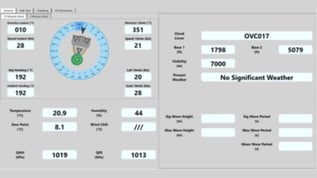
The platform integrates GNSS receivers, motion reference units, radar positioning systems, environmental sensors and distributed telemetry devices within a unified processing environment.
Alarm management and traceability
Alarm handling in RUPDB follows a hierarchical and structured approach. Threshold logic can be applied to both measured and derived parameters, including sector breaches, envelope exceedance and trend-based triggers.
Deadband configuration reduces nuisance alarms while maintaining sensitivity for safety-critical events. All alarms and system state changes are time-stamped and stored within the historical database, providing full traceability for operational review and compliance documentation.
The emphasis is on controlled alarm behaviour rather than reactive notification alone.
Historical logging and replay
RUPDB incorporates embedded memory-resident and disk-based historical databases to maintain a continuous record of system activity. Both measured signals and calculated parameters are stored alongside operator acknowledgements and configuration changes.
Time-window replay functionality enables reconstruction of operational sequences for post-event analysis, training or incident investigation. Data export is supported through structured CSV extraction and snapshot capture in PDF or image format.
Engineering approach
RUPDB is developed and maintained in-house to ensure lifecycle control, continuity and domain-specific optimisation. The design philosophy emphasises deterministic behaviour, mathematical consistency and auditability over feature proliferation.
Its purpose is to provide a stable, transparent and repeatable execution environment for precision monitoring systems operating in demanding marine and energy environments.
From software platform to operational system
RUPDB is engineered to support defined monitoring applications rather than operate as a standalone SCADA product. Its full capability is realised within complete system deliveries designed, engineered and supported by WISE Group.
The platform provides the controlled processing core. The surrounding system architecture (sensors, interfaces, visualisation and domain-specific alarm logic) is engineered for the operational context.
RUPDB is implemented within the following engineered monitoring systems:
Excursion and Position Monitoring
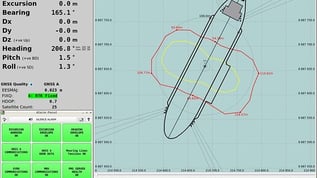
High-precision vessel position tracking with rolling mean calculations, excursion envelope monitoring and structured alarm logic for offshore installations.
Pipeline Telemetry Systems
Distributed data acquisition and flow monitoring platforms supporting integrity assessment and remote operational visibility.
Tanker Berthing Aid Systems
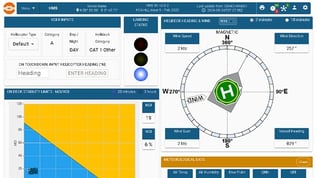
Real-time position, motion and safety parameter monitoring to support controlled approach, hook-up and disconnection operations.
Where to next
RUPDB is the processing core. The sensors, interfaces, displays and alarm logic around it are engineered for each operational context.
In this area: Software overview · DADAS · Orbalux · PACE
Related systems: Excursion and Position Monitoring · Pipeline Telemetry · Tanker Berthing Aid
Also useful: Sensors · Service and support
In the knowledge base: Integration overview: SCADA, TMS and PI
Useful to include
- What has to be monitored: position, motion, telemetry or berthing
- The instruments and protocols already in place
- Alarm, logging and reporting requirements
What happens next
We review the monitoring application and the existing instruments.
We define the processing, alarm logic and interfaces.
You get a scope for delivery, integration and support.
Get in touch
Tell us what the system has to monitor and which instruments it has to work with, and we will come back with how RUPDB and the surrounding system fit.
You can also contact us directly.