







Monitoring systems › Position and Mooring Monitoring
Position and mooring monitoring
RUP Excursion Monitoring System (ExcMS)
Position and motion monitoring for FPSOs and floating wind turbines, with real-time alerts when a unit moves outside its limits.
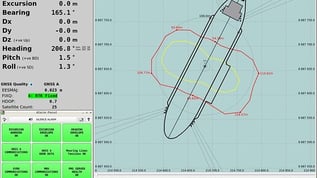
The RUP ExcMS keeps track of where a floating unit is and how it is moving. It measures position and motion in all six degrees of freedom, alerts operators to deviations from set thresholds, and logs the data in RUPDB SCADA for trend analysis and historical review.

How it works
The ExcMS gives operators precise position tracking, real-time alerts for motion discrepancies and the data to analyse them, so they can keep the unit within its operating parameters and deal with issues quickly.
Measure
High-precision GNSS receivers and 6-axis accelerometers track the unit’s movements across all six degrees of freedom.
Detect
Motion data is analysed continuously against set thresholds, and operators are notified of any deviation so they can act straight away.
Record
Data is logged in RUPDB SCADA for trend analysis and historical review, to support decisions and operational safety.
Applications
Where it is used
Oil and gas
FPSO excursion monitoring
Keeps FPSO units within their designated operating boundaries, preventing excessive excursions that could compromise safety and operational integrity.
Offshore wind
Floating wind turbines
Monitors the position and movement of floating wind turbines, supporting structural integrity and compliance with operating standards.
On either, the Mooring Line Tension (MLT) module adds real-time calculation and monitoring of mooring line tensions.
Built for the conditions
Precision components
Advanced GNSS receivers and accelerometers, selected for accuracy and for resilience to interference.
Processing software
Algorithms process and analyse the data in real time, giving operators insight they can act on.
Built for harsh conditions
Designed to withstand harsh marine environments, for continuous operation with minimal maintenance.
GNSS resilience
Positioning through interference
Jamming and spoofing of satellite navigation signals are becoming more common at sea. An excursion alarm is only as good as the position behind it, so the GNSS receivers we specify for the ExcMS are built to hold a reliable position through RF interference, and to tell operators when the signal is under attack.
No receiver is immune to every attack. What matters is that the system holds its position for as long as it can and says clearly when it cannot, because a reading nobody trusts is worse than no reading at all.
Multi-band, multi-constellation
GPS, Galileo, GLONASS and BeiDou are tracked on several frequency bands at once, so interference on one band does not take the position with it.
Interference monitoring
The RF spectrum and the GNSS signals are monitored continuously, and unwanted interference is detected and suppressed before it degrades the position.
Spoofing protection
False or deceptive GNSS signals are detected and resisted, rather than being accepted as a new position.
Alarms in RUPDB SCADA
Jamming and spoofing alarms are raised in RUPDB SCADA alongside the excursion alarms, so operators know straight away when to treat a position with care.
Add-on module
Mooring Line Tension (MLT) module
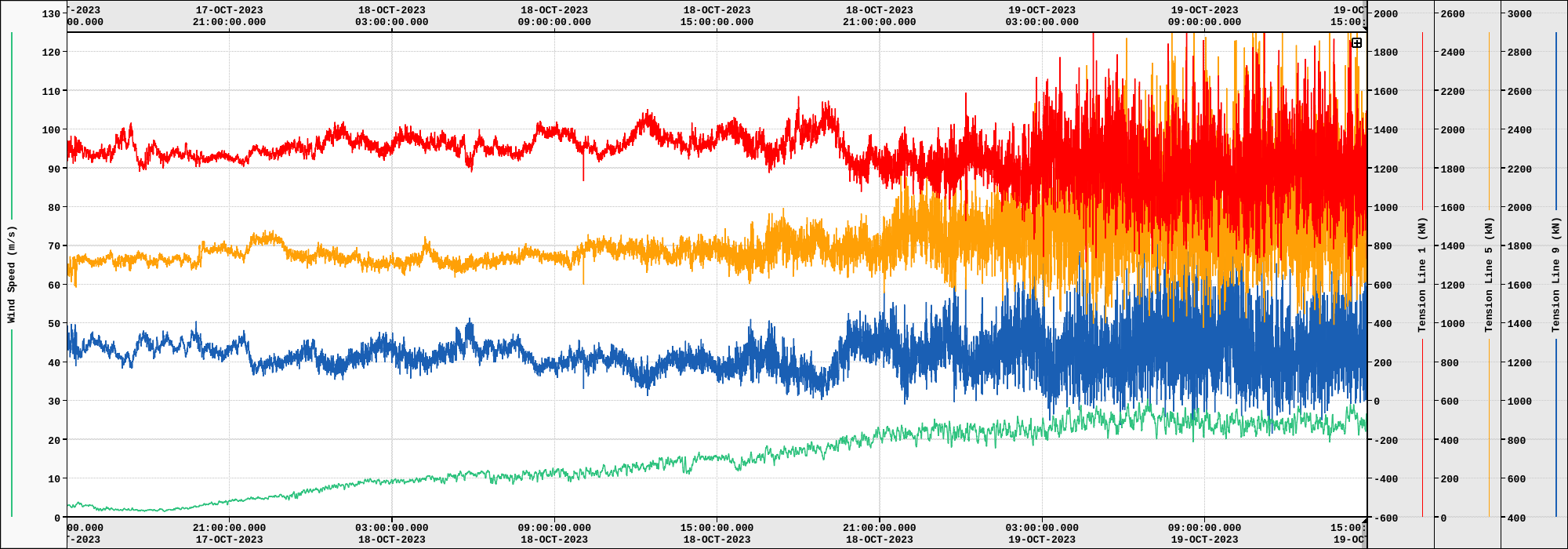
The MLT module extends the ExcMS with continuous monitoring of mooring line tensions, calculated from the unit’s position.
- Continuous monitoring: real-time tracking of mooring line tensions, calculated from position data.
- DNV standards: compliant with DNV-ST-0119 and DNVGL-OS-E301, for floating wind structures and FPSOs.
- High-frequency logging: tensions computed at 1 Hz and logged in the SCADA system for detailed analysis.
- Alarms: visual and audible alarms for tension exceedances, with email alerts, so corrective action can be taken quickly.
Also within a position and mooring scope
Tanker Berthing Aid System
Where the operation is a tanker approaching an FPSO rather than the FPSO’s own station-keeping, the Tanker Berthing Aid System covers the approach, hook-up and disconnection: position, heading and motion presented to the Master and to the FPSO. More on the Tanker Berthing Aid System →
The software underneath
Both systems are built on the RUPDB SCADA platform, which provides the data acquisition, alarm logic and logging the position monitoring depends on. More on RUPDB SCADA →
Where to next
The RUP Excursion Monitoring System sits in Position and Mooring Monitoring, one of six monitoring areas WISE Group delivers.
In this area: Tanker Berthing Aid System · Pipeline Telemetry System
Related systems: Structural Health Monitoring · Vessel Motion Monitoring · MetOcean and weather monitoring
Also useful: RUPDB SCADA software · Sensors and instruments · Service and support
Useful to include
- The floating unit and its mooring arrangement
- Whether mooring line tension is part of the scope
- Any position, motion or SCADA system already installed
What happens next
We confirm what has to be monitored, and whether the MLT module applies.
We define the sensor positions and the RUPDB SCADA setup.
You get a scope for supply, installation and service.
Get the brochure
Submit your email address and we will send the RUP ExcMS brochures, with in-depth information and technical specifications.
Prefer to speak to our team? Contact us here.