





Monitoring systems › Air quality monitoring
Air quality monitoring
Air quality monitoring
Particulate matter, gases and odour, measured alongside the conditions that say where a reading came from.
An air quality reading on its own says that something was in the air. It does not say what put it there. Wind speed and direction at the moment of the measurement are what turn a concentration into an argument about a source, and that is usually what a fenceline dispute, a permit condition or a complaint actually turns on.
Measuring air is a sensor problem before it is a software problem: which pollutants, at what concentrations, in what weather, for how long, and how much accuracy the decision genuinely needs. That is the part WISE Group has been doing across every other parameter for over 30 years.
What gets measured
Air quality is not one measurement. Which parameters matter depends entirely on what is being asked, and a station configured for a city centre is not the one a quarry or a jetty needs.
- Particulate matter, usually as PM10, PM2.5 and PM1, which is what dust complaints, construction consents and quarry conditions are normally written against.
- Gases, typically nitrogen oxides, sulphur dioxide, ozone, carbon monoxide and hydrogen sulphide, with volatile organic compounds where solvents or hydrocarbons are in play.
- Odour, which is often what generates the complaint even when every concentration is inside its limit.
- Temperature, humidity, dew point and pressure, because sensor response varies with them and the data has to be corrected for it.
- Wind speed and direction, without which a concentration cannot be attributed to a source.
Instruments
How it is measured
The instrument follows the question. These are the approaches, and most installations combine more than one.
Sensor-based stations
Compact units carrying several electrochemical and optical sensors at once. Cheaper per point, so more points can be deployed and a site can be covered rather than sampled. The trade is accuracy, and the correction and periodic reference checks that go with it.
Reference analysers
The instrument class that regulatory reporting is usually written around. Larger, more demanding to house and to maintain, and the benchmark that sensor-based stations are judged against rather than a replacement for them.
Particulate and dust monitors
Optical instruments counting and sizing particles as they pass, reporting PM10, PM2.5 and PM1 in real time. This is what most dust conditions on a consent are written against.
Meteorological sensors alongside
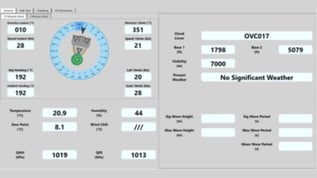
Wind speed and direction, temperature, humidity and pressure at the same point. Without them a concentration cannot be tied to a source, and the sensor data cannot be corrected for the conditions it was measured in.
What WISE Group supplies
The work is the same one we do on every other parameter: establishing what has to be measured and to what confidence, selecting instruments that will survive where they are going, siting them so the reading means something, and bringing the output together with the rest of the site’s data rather than leaving it in a portal of its own.
Where air quality is measured alongside weather and ocean conditions, it is engineered as part of that scope rather than bolted to the side of it.
Servicing, spares and on-site system verification follow the same model as the rest of our instrumentation. Calibration itself is a laboratory activity, and those returns are managed on your behalf with the manufacturer or a certified laboratory.
Kunak reseller in Norway
Kunak AIR Pro stations
WISE Group is the Norwegian reseller for Kunak, whose AIR Pro stations measure several gases and particulate matter at once, carry their own temperature, humidity, dew point and pressure sensors, run autonomously on battery and solar power, and report to the Kunak Cloud platform.
Where to next
Air quality is one of the measurements we supply rather than one of the six monitoring areas the systems section is built around. It is most often specified alongside weather and ocean measurement.
In this area: Kunak air quality monitoring system
Related systems: MetOcean and weather monitoring · Environmental and Wildlife Monitoring
Also useful: Meteorological sensors · Wind sensors · Sensors · Service and support
Useful to include
- Which pollutants matter, and what the limit or condition is written against
- Whether the driver is a permit, a consent condition, a complaint or a process concern
- Whether reference-grade accuracy is required, or indicative monitoring answers the question
- Where a station can be sited, what sits upwind, and what power and communications are there
- How long the measurement has to run, and where the data has to end up
What happens next
We confirm the parameters and the accuracy the decision needs.
We select the instruments and the siting.
You get a system description you can put into a specification.
Get in touch
Tell us what has to be measured and why: the pollutants, the driver behind the requirement, and where a station would sit. Our engineers will come back to you.
You can also contact us directly.