



Monitoring systems › Helideck and Aviation Monitoring › HCA Rev 9c
HCA standard · Moving helidecks
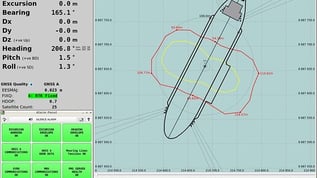
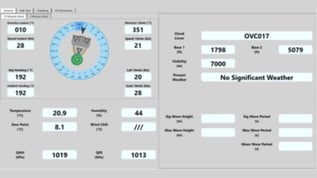
HCA Rev 9c: Helideck Monitoring System and weather data
The Helideck Certification Agency’s standard for HMS and weather data on moving helidecks, implementing CAP 437 Edition 9.
Introduction
This page summarises the key updates in the Helideck Certification Agency (HCA) document Standard Measuring Equipment for Helideck Monitoring Systems (HMS) and Weather Data, Revision 9c (2023).
The revision aligns with CAP 437 Edition 9 from the UK Civil Aviation Authority (CAA), providing detailed technical requirements for moving helidecks: floating installations and offshore vessels subject to deck motion and meteorological variation.
Scope and applicability
Applies to
Moving helidecks, including vessels, FPSOs, semi-subs and floating platforms, where deck motion must be measured and monitored for safe helicopter operations.
Not designed for
Fixed helidecks, which fall under CAP 437 without the HMS motion requirement.
Compliance is typically required for UK-sector installations and may be accepted by other jurisdictions or classification societies that reference CAP 437 and HCA HMS standards.
Key differences: Rev 9b vs Rev 9c
The principal changes from Rev 9b to Rev 9c relevant to HMS and weather-data systems:
| Topic | Rev 9b | Rev 9c (February 2023) |
|---|---|---|
| Sampling Rates | Motion 2 Hz, wind 4 Hz | No change |
| Update Rate | Minimum 0.1 Hz | No change |
| SHR Landing Status Logic | SHR logic applied but rounding method unspecified | Requires use of rounded-up values to determine landing status |
| Declination Handling | May be applied manually | Declination must be automatically calculated and applied |
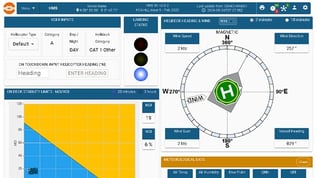
| Marked Discontinuity (MD) | Not explicitly required on HMS display | MD must be visibly presented in the compass rose display |
| Anemometer Switching | Dual anemometers recommended in some configurations | Automatic switching required when a secondary is available |
| Helicopter Type Defaults | Defaults to Category A often implicit | Category A helicopter must be explicitly applied by default at start-up and in pre-landing mode |
| Day/Night Status | Operator input common | Automatic detection required; system must default to night if undetermined |
| Trend Presentation | Trends required for key parameters | Now mandates 20-minute max values and limit lines for Pitch, Roll, Inclination, and SHR |
| Touchdown Heading Alerts | Alerts on invalid data entry recommended | Mandatory alerts if heading input will cause red/amber RWD status |
| Vessel/Helicopter Δ-Heading | Highlighting optional | Numerical and plot highlighting required for large heading or wind direction changes |
| Repeater Light Control | Testing available | Test function must be inhibited during wind or motion exceedance |
| Sensor Faults | General fault indicators required | Specific requirements for excluding faulty data from buffers and flagging missing data (e.g. greying out parameters) |
| Vessel Categories | General categorisation | Category 1 subdivided into “Cat 1 Semi-Sub” and “Cat 1 Other” |
| Helicopter Categories | Based on older type classification | Updated nomenclature reflecting industry changes |
| Screenshot Sharing | Display transmission methods vary | Streamlined screen capture must be available for sending HMS data to flight crew |
| Training Material Approval | Good practice | Formal review and acceptance of training material now required by national aviation authority (e.g. CAA) |
Earlier revisions remain on this site for installations approved under them: HCA Rev 9b and Rev 8c.
Compliance and implementation notes
To comply with CAP 437 Edition 9 through HCA Rev 9c, operators must ensure:
Proper installation and calibration of HMS sensors (motion, wind, temperature, pressure and others).
Verification of data-handling logic and alerting mechanisms, based on the Rev 9c table.
Operator training and documented procedures that reflect the HMS configuration, alert logic and maintenance regime.
A Site Acceptance Test (SAT) and audit, typically by the HCA or the relevant national aviation authority for UK-sector moving helidecks.
Change control and software-version management, so any HMS modification keeps Rev 9c compliance.
How WISE Group supports HCA Rev 9c
Helideck monitoring built around Rev 9c
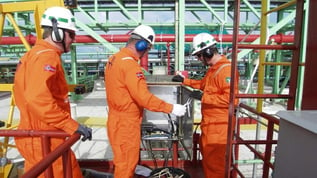
We deliver helideck monitoring and meteorological systems designed around CAP 437 Edition 9 and HCA Rev 9c requirements. Our experience includes:
- System design, hardware selection and integration for moving helidecks worldwide
- Firmware and software configuration in line with HCA logic and alerting rules
- Full calibration, verification and commissioning services
- Upgrade paths from earlier revisions (Rev 8c to 9b to 9c)
- Training, documentation and class/HCA audit support to facilitate certification
Helideck standards
Related standards and revisions
CAP 437
The UK CAA standard for offshore helidecks, and the international benchmark.
Read the overview →HCA Rev 9c
The HCA standard for HMS and weather data on moving helidecks.
You are hereHCA Rev 9b
The previous HCA revision, kept for installations approved under it.
Read the overview →SupersededHCA Rev 8c
An earlier HCA revision, kept for installations approved under it.
Read the overview →Questions about HCA Rev 9c?
Whether you are upgrading from Rev 9b or 8c, or specifying a new moving-helideck HMS, our team can tell you what Rev 9c means for your installation.
Useful to include
- The asset and the helideck type
- The HMS and revision installed today
- When the next audit or SAT is due
Read HCA Rev 9c at the source
The standard is published by the Helideck Certification Agency.
Prefer to talk it through?
Our helideck team can walk you through a Rev 9c upgrade for an existing or planned installation.
Get in touch
Tell us about the helideck and what you need to know. You can also contact us directly.