

Sensors › Current Sensors › Deployment Systems
Sensors
Current Sensor Deployment Systems
Getting a current profiler into the water, and back out again, safely.
An ADCP measures nothing until it is in the water at the right depth, and it stops telling you anything useful once it is fouled or damaged. A Launch and Recovery System (LARS) is what makes deployment a routine job rather than an operation: lowering the sensor over the side, holding it steady at depth, and bringing it back to deck for cleaning and servicing without a crane spread or a dive team.
What a LARS does
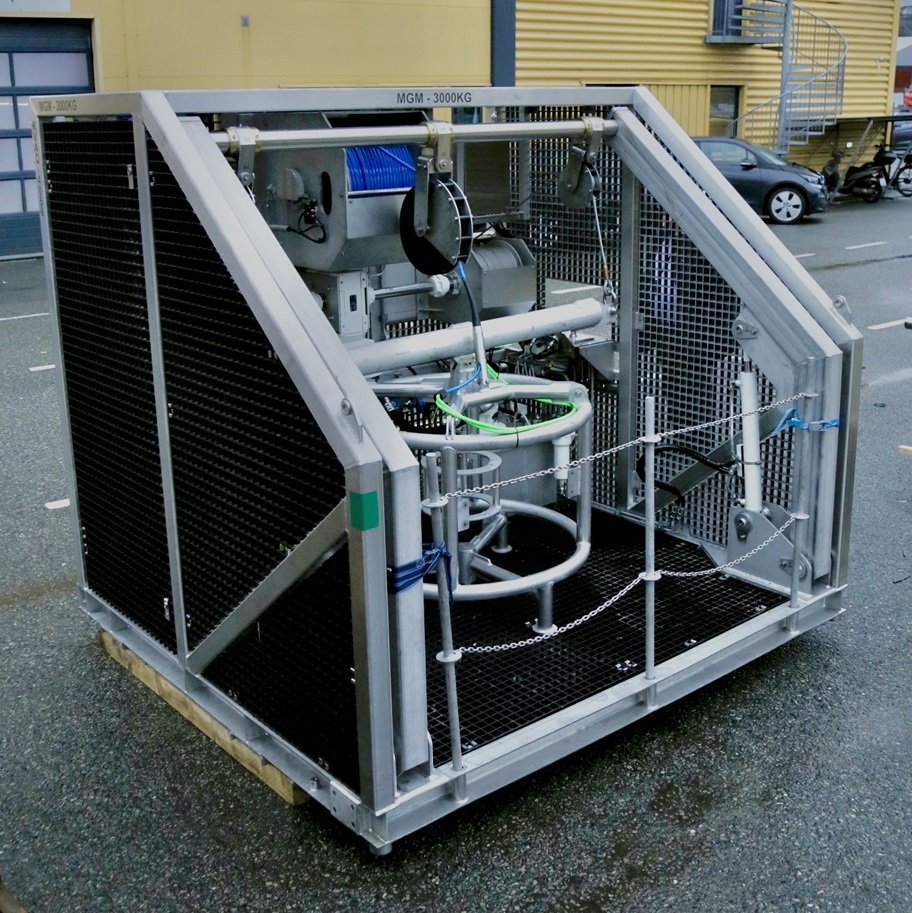
Our launch and recovery systems are purpose-built for the safe deployment of Acoustic Doppler Current Profilers (ADCP) and Acoustic Current Meters (ACM) from a fixed or temporary installation. The sensor sits in a protection frame on a boom, is lowered on a stainless-steel wire rope and umbilical, and is recovered to deck for maintenance. That last part matters as much as the first: a profiler that is awkward to recover is a profiler that stops being serviced.
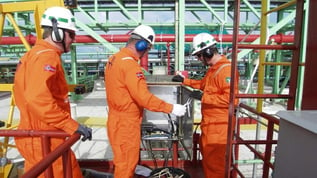
The LARS lowering and recovering a current profiler.
Key features
Ex and non-Ex
Systems are available for Ex Zone 2 (ATEX Ex II 3G ck IIB T4, IECEx) as well as for safe-area installations.
Controlled handling
Hydraulic winches give measured lowering and recovery, with air-driven or electric power units to suit the services available on the installation.
Durability
AISI 316 stainless steel throughout, for a long service life in seawater.
Safety by design
DNV-compliant lifting arrangements, ATEX compliance where required, sensor crash frames and fail-safe operation.
Ease of maintenance
The sensor comes back to the deck, so cleaning, servicing and battery changes happen in a safe working position rather than over the side.
The range
The family is built around the LARS 2.0 (1500), which offers the greatest reach and the heaviest lifting capacity and is the configuration most often specified. Beneath it sit the standard LARS 2.0, for lighter sensors and simpler installations, and LARS Lite, where deck space is at a premium and the deployment is nearshore or shallow-water.
All systems can be adapted for Ex or non-Ex environments, a hydraulic lamella brake can be retrofitted to an installed winch, and subsea mounting frames are available where the profiler is seabed-deployed instead.
LARS 2.0: Ex Zone 2
The standard ADCP hoisting and launch-and-recovery system, rated Ex Zone 2 (ATEX Ex II 3G ck IIB T4, IECEx). Protection frame, boom, wire rope drum, subsea cable and connectors, and umbilical reel spooling.
LARS 2.0 (1500): air-operated
Greater reach and heavier lifts, Ex Zone 2. Protection frame, boom, hydraulic cylinders, air-driven power unit and 100 m stainless-steel wire rope, for installations where instrument air is the available service.
LARS 2.0 (1500): electric drive
The same system with an electric hydraulic power unit in place of the air-driven one, for installations without a suitable instrument air supply. Ex Zone 2, 100 m stainless-steel wire rope.
LARS 2.0 (1500) datasheet
Specifications for the Ex Zone 2 LARS 2.0 (1500), air-operated and electric drive.
LARS 2.0 (1500)
Rated for Ex Zone 2 (ATEX Ex II 3G ck IIB T4, IECEx) and supplied with 100 m of stainless-steel wire rope on the drum and 100 m of subsea cable, this is the fullest specification in the range.
The power unit comes in two forms: air-driven, where instrument air is among the services already available on the installation, and electric, where it is not. Nothing else differs between the two variants.
A delivery comprises
- Sensor protection frame and boom
- Hydraulic cylinders and a hydraulic power unit
- 100 m stainless-steel wire rope drum
- 100 m subsea cable and connectors
- Umbilical reel spooling device
Applications
- Offshore energy projects
- Environmental monitoring
- Oceanographic research
- Hydrographic surveys
Where to next
A deployment system is specified alongside the instrument it carries.
In this area: Current sensors · Wave sensors
Related systems: MetOcean and weather monitoring
Also useful: All sensor types · Service and support
Useful to include
- The instrument to be deployed, and the water depth
- Deck space, services available and the zone classification
- Whether the profiler is suspended or seabed-mounted
What happens next
We confirm the instrument, the installation and the services.
We recommend a LARS configuration or a subsea frame.
You get a quotation for supply, installation and service.
Get in touch
Tell us which profiler you are deploying, from where, and what services are available on the installation, and we will come back with a configuration.
You can also contact us directly.